How to Trade Nifty, BankNifty and Sensex with Option Buying on Live Market Days
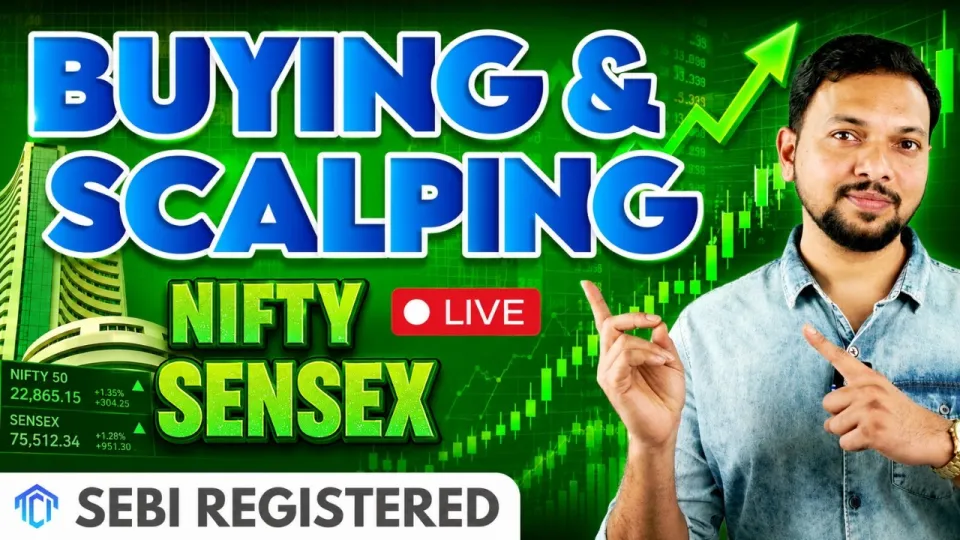
Video: LIVE TRADING Nifty BankNifty and SENSEX | Option Buying | 15 Oct #livetrading
You can order the same kind of articles for your own video to boost it on YouTube and Google. Just message the Telegram bot @sat_sit_bot. Articles with your video embedded are written and posted by the bot itself — on popular topical sites (no ads). Try it free: 50 articles on us.
· based on the channel TRADING CAFE INDIA
Key takeaways
- Option buying caps risk at the premium paid, but time decay works against the buyer every hour the index stalls.
- Nifty, BankNifty and Sensex move on different weights: BankNifty is the most volatile, Sensex the least granular for strikes.
- A live trading session on 15 Oct covered index option buying across all three indices, with viewer comments flagging both a 74,300 Sensex target and a 13,000 rupee loss.
- Position size should be set so a full premium loss on one trade stays under roughly 1-2% of trading capital.
- SEBI-registered research is the baseline: the source channel operates under registration INH000013767.
Trading Nifty, BankNifty and Sensex with option buying means buying call or put options on the three Indian benchmark indices, accepting a capped loss equal to the premium paid while aiming to catch a directional move during live market hours. The workable version of this approach is a pre-defined setup, a fixed premium budget per trade and an exit rule written down before the entry. A live session covering exactly this — index option buying on Nifty, BankNifty and Sensex — ran on the TRADING CAFE INDIA channel on 15 Oct, and viewers can review the Lemonn registered-calls offer that the channel promotes alongside it.
What option buying on Indian indices actually involves
Option buying on Nifty, BankNifty and Sensex is a premium-funded trade: you pay a fixed amount per lot and that amount is the maximum you can lose, which is why it appeals to retail traders who do not want margin calls. The trade-off is theta — the daily time decay baked into the option price — plus the fact that a buyer needs the index to move far enough and fast enough to outrun that decay. A buyer who is right on direction but slow on timing can still lose money.
Three structural differences matter when you trade all three indices in one session:
- BankNifty is the most volatile of the three and reacts hardest to banking-sector news; premiums are expensive and intraday swings are wide.
- Nifty is broader and smoother, with the deepest option chain and the tightest spreads, which makes it the most forgiving index for a buyer.
- Sensex has a wider strike spacing and thinner liquidity away from at-the-money strikes, so fills can slip compared with Nifty.
A practical rule is to pick one index per session as the primary vehicle and treat the other two as confirmation, not as extra trades.
How to structure a live option-buying session step by step
A live trading session works best when it is run as a checklist rather than as a stream of impulses. The sequence below is the one that survives contact with a real market open.
- Mark the levels before 9:15. Write down the previous day's high, low and close for each index, plus the nearest round-number strike. These are the reference points for the whole session.
- Set a premium budget. Decide the maximum rupees you will pay in premium for the day, split it into two or three attempts, and never fund a third attempt from the same budget.
- Wait for the first 15 minutes. The opening range sets the day's character; buying into the first candle is the most common way a buyer donates premium.
- Choose the strike by delta, not by price. An at-the-money or slightly in-the-money strike costs more but decays slower than a far out-of-the-money lottery ticket.
- Define the stop in premium terms. If you paid 100 for an option, a stop at 70-75 caps the loss at a quarter to a third of the position, which is a survivable hit.
- Take partial profit into strength. Selling half at a 30-40% gain and trailing the rest removes the pressure to guess the top.
- Stop trading after two losers. Live sessions go wrong when a bad morning is chased into the afternoon.
Reading the market through the option chain
The option chain is the buyer's main information source: open interest at each strike shows where writers are positioned and where price is likely to stall. Heavy call open interest above the spot acts as resistance, heavy put open interest below acts as support, and a strike where both are thin tends to be traversed quickly. When the index approaches a high-open-interest strike, expect a fight; when it breaks through with rising volume, that strike often becomes the launch point for the next leg.
Two signals are worth watching alongside the chain: the India VIX, which tells you whether premiums are cheap or expensive relative to recent realised moves, and the behaviour of the index heavyweights. Buying a Nifty call while the largest private banks are red is a low-quality trade even if the chart looks fine.
Position sizing and the loss that viewers keep reporting
Position sizing is the single variable that decides whether option buying is a business or a gamble. A common reference point is to risk no more than 1-2% of trading capital on a single option purchase, which means a trader with 1,00,000 rupees of capital should not be paying more than about 2,000 rupees of premium per attempt. At that size, a total loss on one trade is an inconvenience rather than a setback.
The comments under the live session are a useful reality check: one viewer reported losing 13,000 rupees in a single day, while another was still holding a losing position and asking whether to keep holding the call. Both situations usually trace back to the same cause — a position that was too large for the account and had no exit rule attached. The fix is mechanical: size by premium, write the stop before entry, and treat a losing option as a decision to be made in advance, not in the moment.
Common questions from live trading viewers
Viewers of index option-buying streams tend to raise the same practical doubts, and they are worth answering directly.
- "The index went to a high price today — did I miss it?" A move that has already happened is not a setup. Buying after an extended run means paying peak premium for the worst risk-reward of the day.
- "Can I hold the call overnight?" Holding a bought option overnight exposes you to gap risk and another night of decay; it is a different trade from an intraday one and should be sized smaller.
- "Which index should I trade?" Nifty for depth and tighter spreads, BankNifty for movement if you can handle the premium, Sensex only if the specific strike has visible liquidity.
- "How far can Sensex or Nifty go in a day?" Nobody knows in advance; targets like a specific Sensex level are scenarios, not forecasts, and a trader should be positioned to react rather than to predict.
Risk controls that keep an option buyer in the game
Risk control in option buying is mostly about what you refuse to do. Refuse to average down on a losing option — adding to a decaying position doubles the decay. Refuse to trade all three indices simultaneously, because correlated positions are one position with triple the cost. Refuse to increase size after a losing morning; revenge sizing is the fastest route from a bad day to a bad month. Keep a written log of each trade with entry premium, exit premium, index and reason, because the log is the only reliable evidence of whether the setup has an edge.
Useful links
- Lemonn registered calls and affiliate offer
- Nifty and Sensex VIP setups tool
- Free Telegram channel for trades and BTST news
- XM broker link for global users
- CoinSwitch Pro signup for crypto and gold calls
Bottom line
Option buying on Nifty, BankNifty and Sensex rewards preparation far more than prediction: a fixed premium budget, a delta-based strike choice, a stop written before entry and a hard cap of two losing trades per session do most of the work. The live format is valuable precisely because it shows the messy parts — hesitation, holding a loser, chasing a move — that a clean backtest hides. This breakdown was built around the live trading session published by TRADING CAFE INDIA, a channel registered with SEBI as a research analyst under INH000013767; registration does not guarantee returns, and every viewer should treat the content as education and verify any call independently. If you want the channel's registered-call offering, start with the Lemonn signup link and read the risk disclosures before committing capital.
Source: LIVE TRADING Nifty BankNifty and SENSEX | Option Buying | 15 Oct #livetrading · Markdown version
Questions & answers
Is option buying safer than option selling for a retail trader?
It is simpler rather than safer. A buyer's maximum loss is the premium paid, so there is no margin call and no tail risk beyond the position, but time decay means the index must move in your favour quickly. Sellers win more often but carry unlimited theoretical risk, which is why buyers need strict premium sizing instead of strict stop-loss hunting.
How much premium should I pay for a Nifty or BankNifty option?
A workable ceiling is 1-2% of trading capital per attempt. With 1,00,000 rupees of capital that is roughly 1,000-2,000 rupees of premium per trade, which allows several attempts in a session without a single loss wiping out the account. BankNifty premiums are higher, so the same rule usually means fewer lots or a further out-of-the-money strike.
Should I hold a bought call overnight if it is in loss?
Holding a losing bought option overnight adds gap risk to time decay, and the position was likely sized as an intraday trade. If the reason for entry is gone, the cleaner action is to exit and reassess the next morning with fresh premium and a fresh setup rather than hoping for a gap in your favour.
Why do Nifty, BankNifty and Sensex behave differently on the same day?
Each index has a different composition and weighting. BankNifty is concentrated in banking stocks and moves fastest, Nifty spreads across sectors with the deepest option liquidity, and Sensex has wider strike spacing and thinner books away from at-the-money strikes. The same news can therefore produce very different percentage moves and very different option premiums across the three.